
CatPure™ Fluc saRNA
Catalog#: CT227
100 μg
500 μg
1 mg
bulk
Product Overview
Fluc Self-Amplifying RNA (saRNA) is engineered to enable sustained and amplified expression of a firefly luciferase. Luciferase was originally extracted from the firefly (Photinus pyralis) and can catalyze the oxidation of luciferin to produce oxyluciferin, emitting yellow-green bioluminescence (wavelength of 550-570 nm) whose intensity directly reflects the expression level of luciferase. Unlike conventional mRNA, the saRNA leverages mRNA coding capacity with intrinsic self-replicating machinery for sustained luciferase expression.
Applications
• Positive Control for saRNA Transfection: Validating transfection efficiency and system performance.
• Delivery System Screening: Assessing nanoparticle/saRNA formulation efficacy in delivery applications.
CATUG® CatPure™ Fluc saRNA
• Based on VEEV self-replicating system with slight mutation to mitigate immunogenicity.
• A Cap1-AU structure with high capping efficiency.
• 100% substitution with 5-methylcytidine (m5C) for improved protein expression and reduced innate immune response.
• A 100A poly(A) tail to mimic natural mature mRNA.
• Oligo-dT purification ensures high quality and purity.
• Carefully controlled processes to minimize batch-to-batch variation.
*For Research Use Only. Not for use in diagnostic procedures.
Specifications
Description
Fluc saRNA (5mC)
RNA length
9449 nt
Concentration
1 mg/mL
Storage buffer
1 mM sodium citrate, pH 6.5
Storage conditions
below - 65℃
Shipping conditions
Dry ice
Analytical Items
Test
Method
Appearance
Visual
pH
USP<791>
Content
UV
Purity (A260/A280)
UV
Purity
HPLC
Integrity
CE
Residual Protein
Nano Orange
Residual dsRNA
ELISA
Residual DNA template
qPCR
Endotoxin
Gel-clot method
Testing Data
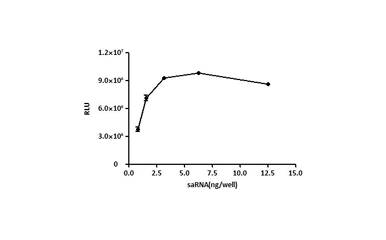
In vitro expression: Cell-based Assay
Learn more
Figure 1. The saRNA samples were delivered into 293T cells using a transfection reagent at doses ranging from 0.781 to 12.5 ng per well. 48 hours post-transfection, firefly luciferase (FLuc) activity was measured by adding the D-luciferin substrate and recording luminescence with a microplate reader. The observed luminescence confirmed that FLuc protein was successfully expressed in the transfected cells.
contact us